5 Star Review: What It Means and How to Earn Honest Ones
A 5 star review is more than a perfect score. Learn what it means for customers and how to invite honest feedback without asking for a particular rating.

The popular advice to collect nothing but five-star reviews gives restaurant owners the wrong target. A believable profile should help guests decide whether a business suits them, not make every visit look flawless. Honest detail matters more than a spotless score.
For independent restaurants, cafés and bakeries, the practical job is to make feedback easy, ask consistently and fix recurring problems. Reward-based tools such as review² also require a clear-eyed look at Google's restrictions. A genuine customer and a working verification system don't make an incentivized review acceptable to Google.
What a 5 Star Review Means to Customers
A 5 star review is the highest rating a guest can leave on Google. It usually means the visit went well overall, not that every pastry, service interaction or minute of waiting was perfect.
Owners shouldn't read every lower rating as a rejection. A guest might love the coffee but find the room noisy, or praise the food while mentioning slow payment. Those distinctions make the written comment worth reading.
What each star rating usually signals
These are practical interpretations, not fixed definitions. The comment should guide the owner's response.
| Stars | Usual customer reading | First thing to check |
|---|---|---|
| 1 star | Serious failure, often one incident | The process that broke that day |
| 2 stars | Clear problem the business could fix | Recurring complaint about the same issue |
| 3 stars | Mixed experience, praise and complaints | Which parts of the visit guests liked and disliked |
| 4 stars | Solid visit with a small gap | The one detail that kept it from five stars |
| 5 stars | No complaints worth mentioning | The specific praise guests repeat |
Prospective guests can scan the average and recent comments before deciding whether to read further. A single enthusiastic review contributes to that picture, but it doesn't replace a useful collection of experiences.
In 2025, 55% of consumers said they would consider only businesses rated between 4 and 5 stars, according to Search Engine Land's summary of review research. For a café or bakery, that makes a strong average an important consideration threshold, rather than proof that every visitor expects perfection.
Read the profile as a guest would
Owners should check whether recent comments answer practical questions about freshness, seating, service and dietary options. The relevant review sites for businesses can differ, so feedback collection should reflect where prospective customers look.
The right target is consistent quality and visible honesty, not a collection of perfect scores.
Why a Perfect Score Can Work Against You
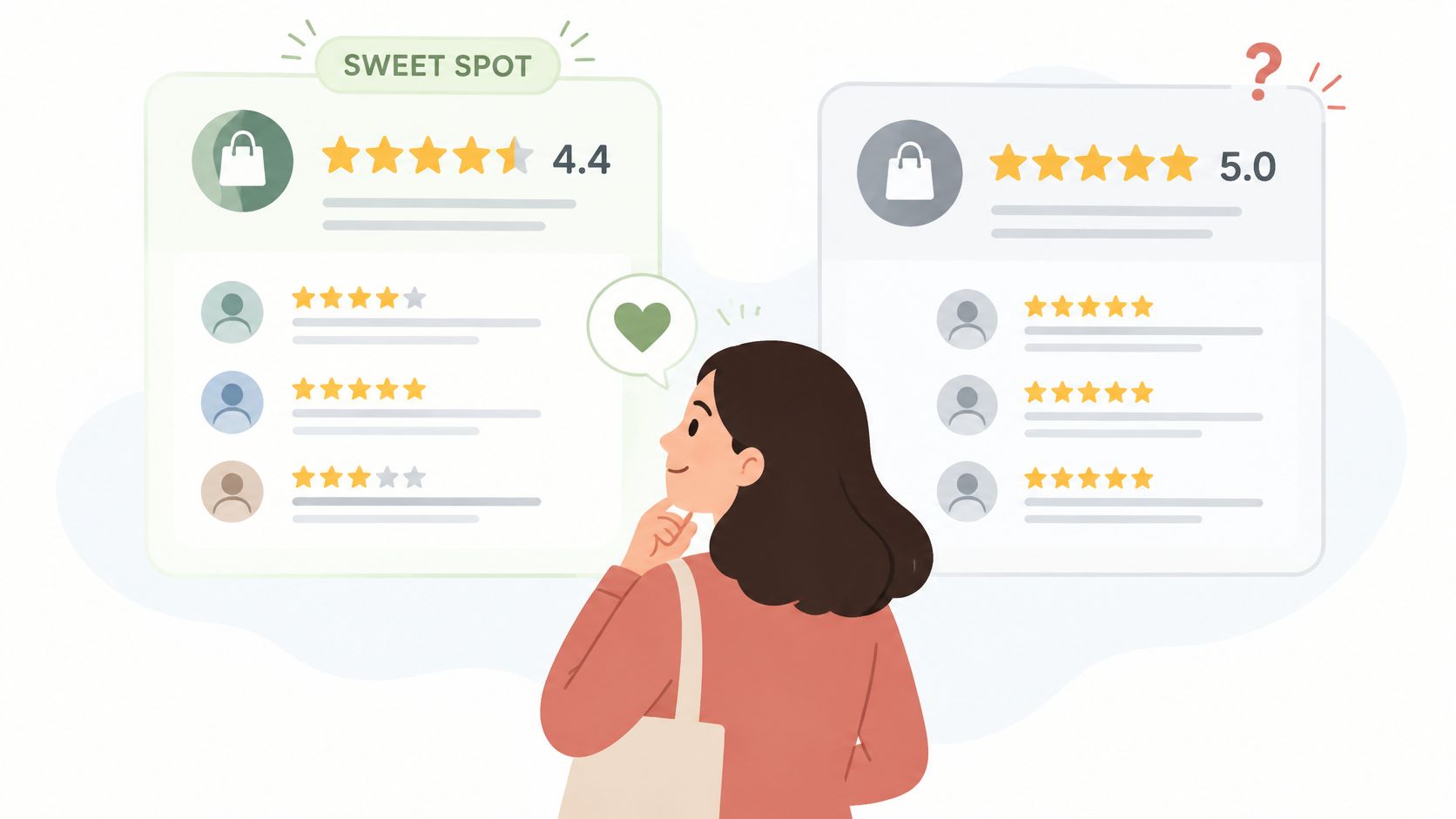
A perfect average isn't automatically the most persuasive result. In e-commerce product research, Northwestern University's Medill Spiegel Research Center found that purchase likelihood peaked at average ratings of approximately 4.2 to 4.5 stars, then declined as ratings approached 5.0; a product with five reviews also had purchase likelihood 270% greater than a comparable product with no reviews.
Those findings concern online product purchases. Restaurant and café results will differ, so owners shouldn't treat that range as a hospitality performance target or try to engineer their average toward it.
Useful detail beats empty perfection
Consider a hypothetical comparison. A restaurant with a 4.6 average has comments describing weekend waits, a lively dining room and good vegetarian choices. Another has a 5.0 average filled with generic praise.
The first profile gives a prospective guest something to work with. Someone planning a quiet conversation might choose another venue, while a group seeking a lively meal might book confidently. Neither decision requires the restaurant to be universally suitable.
The flawless profile leaves more unanswered questions. Repetitive praise can look curated, even when the business hasn't manipulated anything.
A credible profile helps guests choose accurately. It doesn't need to persuade everyone.
Keep quality high without curating the score
A strong rating still matters. Owners shouldn't hide positive feedback, welcome avoidable failures or manufacture criticism to make a profile appear authentic.
Instead, they should:
- Keep collecting genuine experiences. A broader collection gives readers more context than isolated praise.
- Answer criticism openly. A measured response can explain what the team checked or changed.
- Prioritize useful descriptions. Comments about actual visits help guests judge suitability.
Owners pursuing better ranking on Google should keep visibility ambitions separate from promises about review scores. Let genuine feedback determine the average, while the team concentrates on the visit itself.
Google Rules for Incentives and Selective Requests
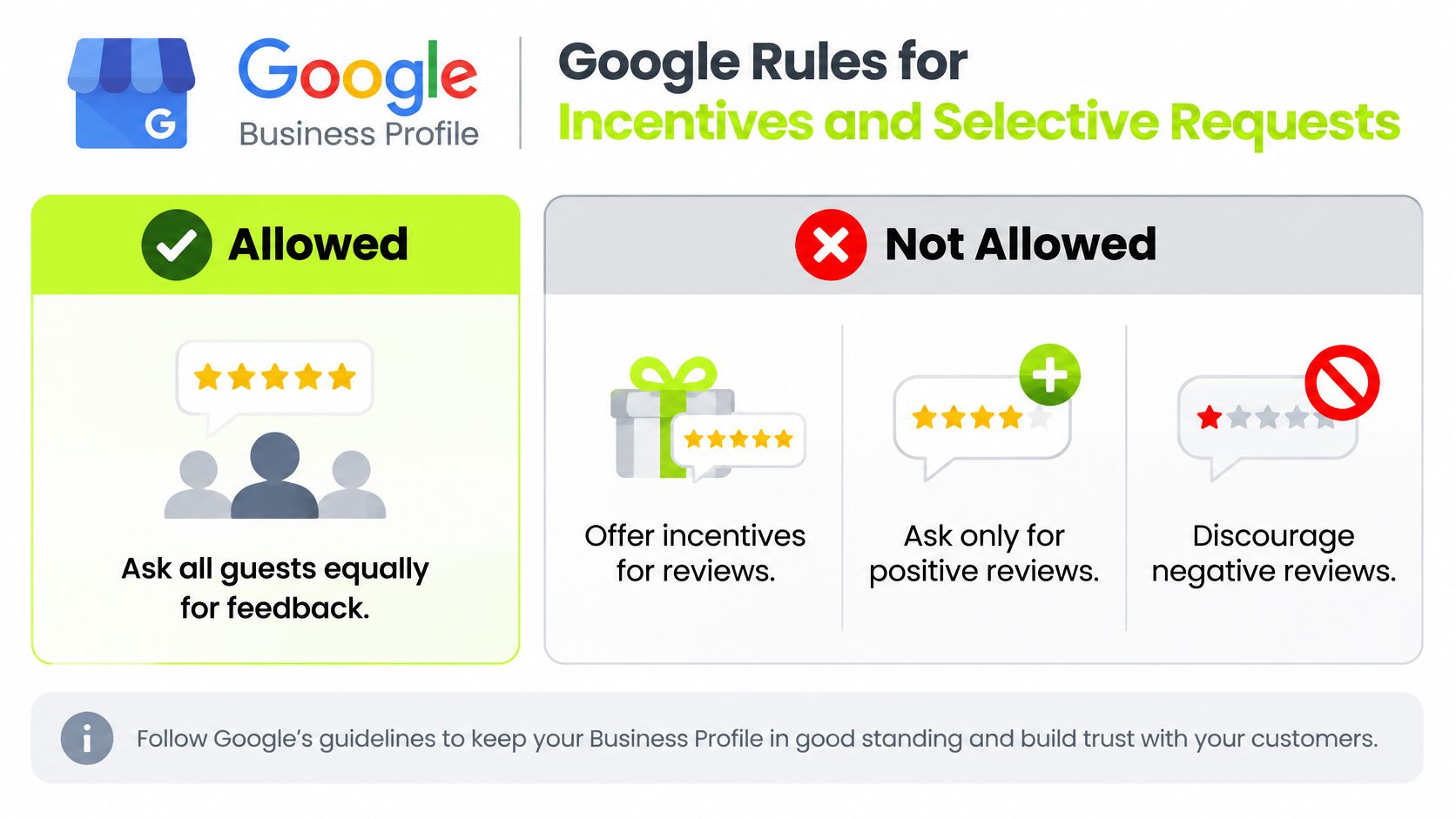
An honest review can still break platform rules if a business rewards someone for posting it. Google's restrictions aren't optional, and making a reward available for every star rating doesn't remove the incentive problem.
Google's guidance on prohibited review practices prohibits incentives for reviews, selective solicitation of positive reviews and discouraging negative reviews. Paying directly or in kind for reviews falls within fake engagement.
Common review requests and their policy status
| Practice | Status under Google policy | Reason |
|---|---|---|
| Asking every guest for feedback | Permitted | Request is open to all experiences |
| Offering a discount or free item for posting a review | Prohibited | Compensation in exchange for posting |
| Requiring a minimum star rating | Prohibited | Selective solicitation of positive reviews |
| Routing unhappy guests away from Google | Prohibited | Discourages negative reviews |
| Replying to negative reviews | Recommended | Shows care and fixes problems in public |
| Single-use coupon after the review is verified | Still a reward tied to posting | Verification does not make the review policy compliant |
The recommended response practice in the table is operational advice, not a requirement to reply. The prohibited practices are different: owners shouldn't build them into a campaign at all.
Replace steering with equal access
A satisfaction survey shouldn't become a gate that sends happy guests to Google and unhappy guests only to a private form. Both groups should have the same opportunity to leave a public review, alongside access to direct customer service.
Staff also shouldn't require a particular rating, offer more for stronger praise or pressure a guest to rewrite criticism. A free drink offered after a review is detected remains compensation tied to posting.
Single-use coupons prevent repeat redemption. Review verification checks whether a review appeared. Neither control overrides Google's rules.
Practical rule: The safest Google review request is open to every guest, with no reward tied to posting.
Before launching a campaign, managers should read the current policy pages and remove any reward-dependent review step. If reviews disappear or a profile is restricted, they should pause the affected campaign, check its wording and workflow, and use Google's official support or appeal process where available. A replacement campaign shouldn't repeat the same prohibited arrangement.
How to Ask Every Guest for Feedback
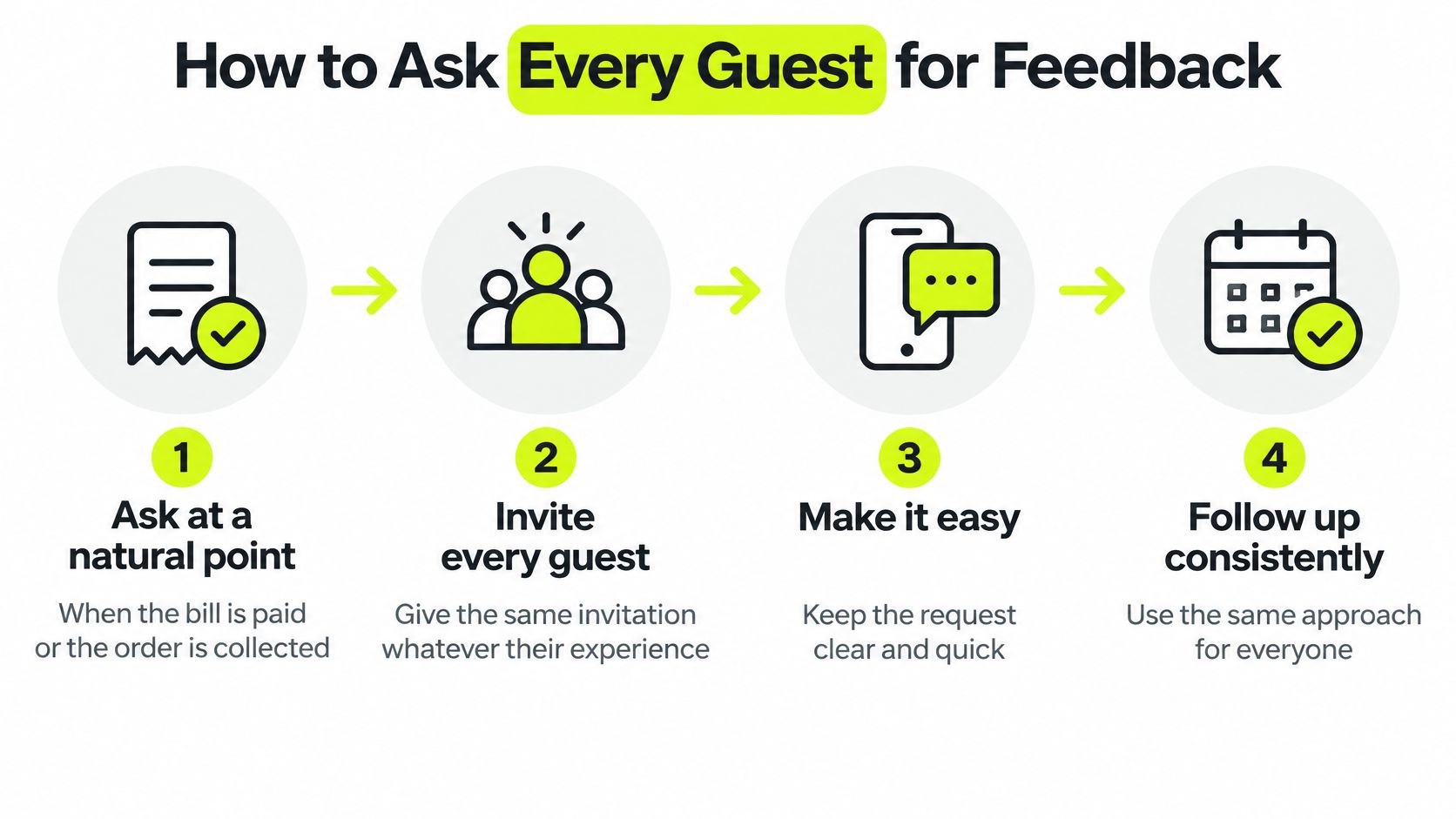
Every guest should receive the same invitation, whatever happened during the visit. The request belongs in the normal service process, not in a separate routine reserved for regulars or people who compliment the food.
Consistency also makes staff training easier. Employees don't need to judge who seems likely to praise the business before offering the review route.
Build the request into service
Choose a natural moment. Payment, order collection or the end of table service provides a predictable point for the invitation. Asking only after a compliment makes the process selective.
Use neutral wording. A short invitation such as Feedback about the visit is welcome through this QR code asks for an experience, not praise. Staff shouldn't add a request for a particular score.
Make the same route visible throughout the venue. Table cards, receipts and takeaway bags can carry the same review link or QR code. A guest shouldn't need special permission or a staff member's approval to reach it.
Leave the rating to the guest. Staff shouldn't explain which score would help the business most or suggest that anything below the highest rating counts as failure. That adds pressure instead of inviting an independent judgment.
Offer direct help without closing the public route. A guest with a complaint should be able to speak to a manager and still access the same review invitation. Staff should record the issue for follow-up rather than treat private feedback as a substitute for public feedback.
Train for a short request and an easy refusal. Staff can point out the QR code once, then return to service. A declined invitation shouldn't trigger repeated reminders, hovering or requests to see the finished review.
Check coverage during the weekly team review. Managers should confirm that counter customers, takeaway guests and unfamiliar visitors receive the same opportunity as regulars. Gaps often arise when individual employees improvise the process.
Make consistency observable
A manager can walk the customer journey from entrance to payment and check where the invitation appears. A missing table card, covered counter sticker or receipt template without the link is an operational issue the team can fix.
The fairness test is straightforward: a guest with a bad experience should receive the same access and treatment as a delighted guest. If staff would hide the QR code after a complaint, the process needs changing.
Consent, Coupons and Staff Redemption
Optional name-and-email capture should stay separate from the review request. A guest's decision to share feedback or redeem a coupon isn't permission to receive promotional messages.
The UK Information Commissioner's Office direct-marketing guidance says consent must be specific, informed, freely given and unambiguous, and as easy to withdraw as to provide; electronic marketing to individuals generally requires consent unless the narrow soft opt-in conditions apply. Owners should check the rules that apply where their business operates.
Keep marketing permission explicit
An optional signup should use a clear, unchecked marketing choice describing the messages the business will send. Marketing emails and texts should identify the sender and include an opt-out route.
Managers should retain evidence of consent and honor withdrawals promptly. An operational message explaining a coupon shouldn't become a promotional mailing-list subscription.
Treat coupon controls as redemption controls
review² offers optional consent-based guest contacts and single-use reward coupons with a live animation. Staff hand over the reward only when the guest presents the live coupon on their own phone, not a static screenshot.
Its standard workflow verifies that a Google review appeared before making the reward available. That distinction matters: Google's contribution policy prohibits compensation for posting, revising or removing reviews, so verification doesn't make that arrangement compliant.
Any separate visit-based coupon should be genuinely independent of posting, rating or wording. Owners shouldn't assume that a review-dependent product workflow can serve as an independent visit reward.
The team's final checks are concrete:
- Consent stays optional. The marketing box starts unchecked.
- Messages allow withdrawal. Every marketing message includes an opt-out.
- Redemption uses the live screen. Staff reject static screenshots.
Respond to Criticism, Track Results and Set Up the Routine
A useful negative-review response thanks the guest, names the specific issue and states the check or change being made. It should stay short, avoid an argument and never ask the guest to remove or edit the review.
For example, a hypothetical response to a long wait can acknowledge the delay and explain that the manager is checking kitchen-to-counter handoffs. It shouldn't announce that the problem is solved before anyone has investigated.
Review measures to track and how often
| Measure | What it tells the business | How often to check |
|---|---|---|
| New review count | Whether requests are reaching guests | Weekly |
| Average star rating | Overall trend, not any single review | Monthly |
| Share of reviews with specific details | Whether feedback describes real visits | Monthly |
| Response time to negative reviews | Whether complaints get a timely, calm reply | Weekly |
| Recurring complaint themes | Operational fixes such as wait times or noise | Monthly |
These are recommended management intervals, not platform requirements. The average doesn't need constant refreshing, while unanswered complaints and missing invitations deserve prompt attention.
Recurring themes are especially useful for a small team. Repeated mentions of slow collection, unclear allergen information or noisy seating give managers specific processes to inspect. A shared spreadsheet can record the issue, responsible person and follow-up status.
The most useful outcome of a complaint is a checked process, not a more defensive reply.
Give the routine a named owner
A manager should decide where invitations appear, approve neutral wording and train staff before launch. The same person should check complaint logs and assign practical fixes, rather than treating reputation management as a request for more praise.
A focused effort to fix an online reputation should connect public responses with changes in service. Replying politely won't resolve a recurring payment queue or incorrect opening information.
A subscription service such as review² combines QR stickers, review verification, single-use reward coupons, consent-based guest contacts and weekly email reports showing new reviews, star ratings and progress. Those reports reduce repeated manual checking, but the reward-for-review model conflicts with Google's incentive policy; the service cannot guarantee reviews, ratings or rankings.
Google's Business Profile enforcement guidance lists possible restrictions including blocking new reviews, temporarily unpublishing existing reviews and displaying a warning that fake reviews were removed. Google decides whether a review remains published, including reviews written in exchange for gifts.
Owners considering a subscription should check current terms and pricing directly, keeping billing periods, VAT, separately ordered stickers and reward costs distinct. The sample demo illustrates a possible guest experience, but doesn't publish or verify a review, issue a redeemable reward or enroll a guest in marketing.
review² offers QR-led review collection, verification, single-use coupons and weekly reporting, with Google's incentive restrictions remaining a firm consideration. Restaurant, café and bakery owners can visit review² to explore the demo and assess the workflow before deciding whether it fits their feedback process.