Retail Store Review: What Shoppers Check and What to Do
Retail store review guide: what shoppers assess, how to read ratings, respond to criticism and manage feedback within Google's rules.

When did a four-star review start telling you more than a five-star one?
Most shop owners still measure reputation by the number in the header. Shoppers stopped reading that way years ago. They open the page, scan the average, then drop straight into the newest comments to find out whether the queue moves, whether the item they came for is on the shelf, and whether anyone answered the complaint underneath.
That gap is where most review programs go wrong. A store can lift its average and learn nothing, or keep an unremarkable score and fix the three things customers keep writing about. The working version looks like this: know what shoppers check, know which numbers mean something, read the text properly, reply with a reason, and run a feedback program that doesn't tilt what guests say.
What Shoppers Look for in a Retail Store Review
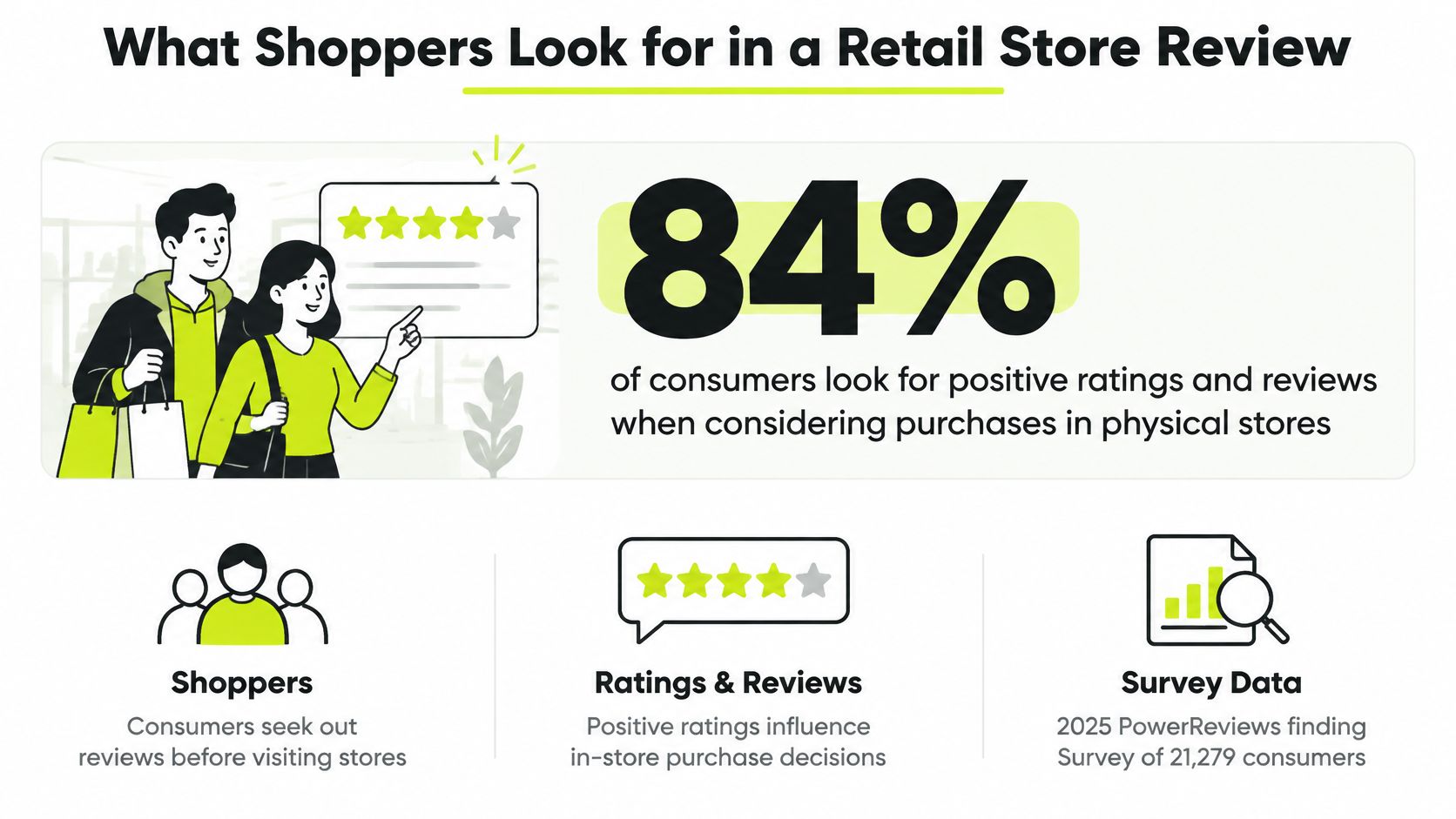
In 2025, 84% of consumers said they look for positive ratings and reviews when considering purchases in physical stores, according to PowerReviews' survey of 21,279 consumers. That isn't a promise about what any program will deliver. It's a description of a habit already running before a customer reaches your door.
The habit is narrow. Shoppers don't read a store page like an analyst reading a report. They want confirmation on a handful of practical points, preferably from someone who was in the building recently.
The Seven Checks Behind Most Store Reviews
| Shopper check | What shoppers are looking for | What it signals to the store |
|---|---|---|
| Product availability | Whether the items they want are in stock | Inventory accuracy and range planning |
| Staff helpfulness | Friendly, knowledgeable help on the floor | Training and staffing levels |
| Price and value | Fair prices and visible deals | Pricing consistency and shelf labels |
| Store cleanliness and layout | Tidy aisles and easy navigation | Daily store standards |
| Checkout and wait times | Quick, smooth payment | Staffing during peak hours |
| Returns and refunds | Clear policy and an easy process | How the policy is explained at the till |
| Accessibility | Step-free access, parking and clear paths | Physical access features and layout |
Read the middle column as the shopper's real question. "Product availability" means "will the thing I came for be there". "Staff helpfulness" means "will someone help me without me waving at three people". The right-hand column turns the same sentence around: it's the part of the business that can be checked and changed on a Monday morning.
How a Shopper Reads a Store Page in Under a Minute
The order is predictable. The average rating comes first because it's the largest element on the page. The newest comments come second, and readers typically read two or three. The last check is whether the owner replies, and how.
A shop that answers a one-star review with a specific fix reads as more reliable than a shop with a perfect score and no replies at all.
Where those reviews sit matters too. Review sites for businesses draw different audiences, and a page nobody browses can hold a spotless rating that changes no one's mind.
The seven checks double as a self-audit. Walk your own store with them in hand and ask whether a stranger could confirm each one within five minutes, without asking staff. If the answer is no, that's the gap a review will eventually describe.
Reviews became a public record quickly. Amazon introduced customer reviews in 1995 and eBay launched its Feedback Forum in February 1996, as a history of online reviews sets out, and the pattern hasn't changed since: customers publish, the public reads, and businesses live with the result. A store's reputation is public by default, which makes how you handle feedback part of what shoppers read next.
Ratings Versus Review Volume Explained
A star average is a summary of a summary. It collapses dozens of different experiences into one decimal, and it hides the two things an owner most needs: how many people bothered to speak, and how spread out their opinions were.
A meta-analysis of 28 studies on reviews and sales found that review count, star ratings, rating dispersion, helpfulness, review length and sentiment can all influence sales, with the size of the effect varying by product category. Volume and quality work through different mechanisms, so tracking one as a stand-in for the other hides the pattern. The same body of work reports that purchase likelihood tends to peak when the average sits around 4.0 to 4.7 stars and can fall as ratings approach a perfect 5.0. A flawless score is not the target.
The Six Numbers Worth Tracking
| Metric | What it shows | What to watch for |
|---|---|---|
| Average rating | Overall sentiment across reviews | Swings caused by a small number of reviews |
| Review count | Volume of feedback over a period | Sudden bursts that don't match real visits |
| Rating distribution | Share of one-star and five-star reviews | Sharp shifts in either extreme |
| Review recency | How current the feedback is | Older reviews dominating the average |
| Median rating | Typical score, less affected by outliers | Gaps between median and average |
| Location segments | Results for each store or category | Comparisons across unlike categories |
Put the table to work on a small sample. Say a shop collects eight reviews in a month, six of them five stars from regulars who came in during a launch week. The average reads 4.8 and looks excellent. Nothing in that figure shows whether the Saturday queue, the returns desk or the stock accuracy improved at all. The count is too small to prove anything, and the average is doing all the talking.
Practical rule: judge a store on a credible, recent body of reviews, not on the size of the number in the header.
Build the routine around segmentation. Pull results by location, by category and by month, then report the median alongside the average, the distribution of one-star and five-star shares, the tenancy of old reviews in the total, and recency. Investigate any week where the extremes move sharply in either direction.
Compare each store with stores like it. A small format city shop and an out-of-town unit with parking don't share a benchmark, and a category where shoppers research heavily won't behave like one where they buy on impulse. One universal target will either flatter the weak store or punish the strong one.
Spotting Recurring Problems in Review Text
A four-star review can hold the most useful sentence a shop reads all month. The star says someone left mildly disappointed. The sentence says the changing room was locked, the second item was out of stock, or the return took three visits. Owners who only read the average never get that sentence.
None of this is helped by the state of review quality. BrightLocal's 2025 local consumer review survey reported that only 24% of consumers were confident they had spotted a fake review during the previous year, and 35% of respondents in a separate 2025 consumer study called review spam a serious problem. Stars are getting harder to trust. Text, checked against your own records, is not.
Six Themes Worth Tagging Every Month
| Theme | What to look for in the text | Operating area to check |
|---|---|---|
| Wait times | Mentions of queues, slow service or long waits | Staffing and till coverage at peak hours |
| Stock accuracy | Items missing, substituted or out of stock | Inventory counts and shelf replenishment |
| Returns | Refund or exchange complaints | Returns policy wording and staff training |
| Accessibility | Comments on steps, aisle width or parking | Entrance, layout and signage |
| Staff conduct | Comments on attitude, helpfulness or attention | Training, supervision and shift handovers |
| Checkout pricing | Confusion about prices or totals at the till | Shelf labels and till price checks |
Before tagging, filter each review on four questions. Was the experience specific enough to be verified? How recent is it? Which theme does it touch? And has the complaint already been resolved and acknowledged? A vague one-line verdict is worth less than a dated paragraph describing a Tuesday afternoon.
The Monthly Text Routine
Assign one person to run this in a fixed slot each month, because it takes an hour and gets skipped otherwise.
- Tag every review from the last 30 days by theme and by star rating.
- Count the repeats and sort the themes by how often they appear, not by how angry they sound.
- Check the counts against your own service records where the law allows, such as shift rotas, stock files or till logs, to see whether the reviews match the operating reality.
- Rank the top three themes and pick one to fix this month.
- Write down the success signal before you start: what a customer would have to mention next month for you to call it improved.
Read the whole pattern, not the headline number. A cluster of uniform praise persuades fewer shoppers than specific, mixed feedback with visible replies underneath.
Finish by naming the theme you'll fix first and how you'll know. If the complaint is the queue at 5pm, the signal is three or more reviews that mention fast checkout, or none that mention waiting. That's a clearer target than "get more five-star reviews", and it's testable in 30 days.
How to Respond to Negative Reviews
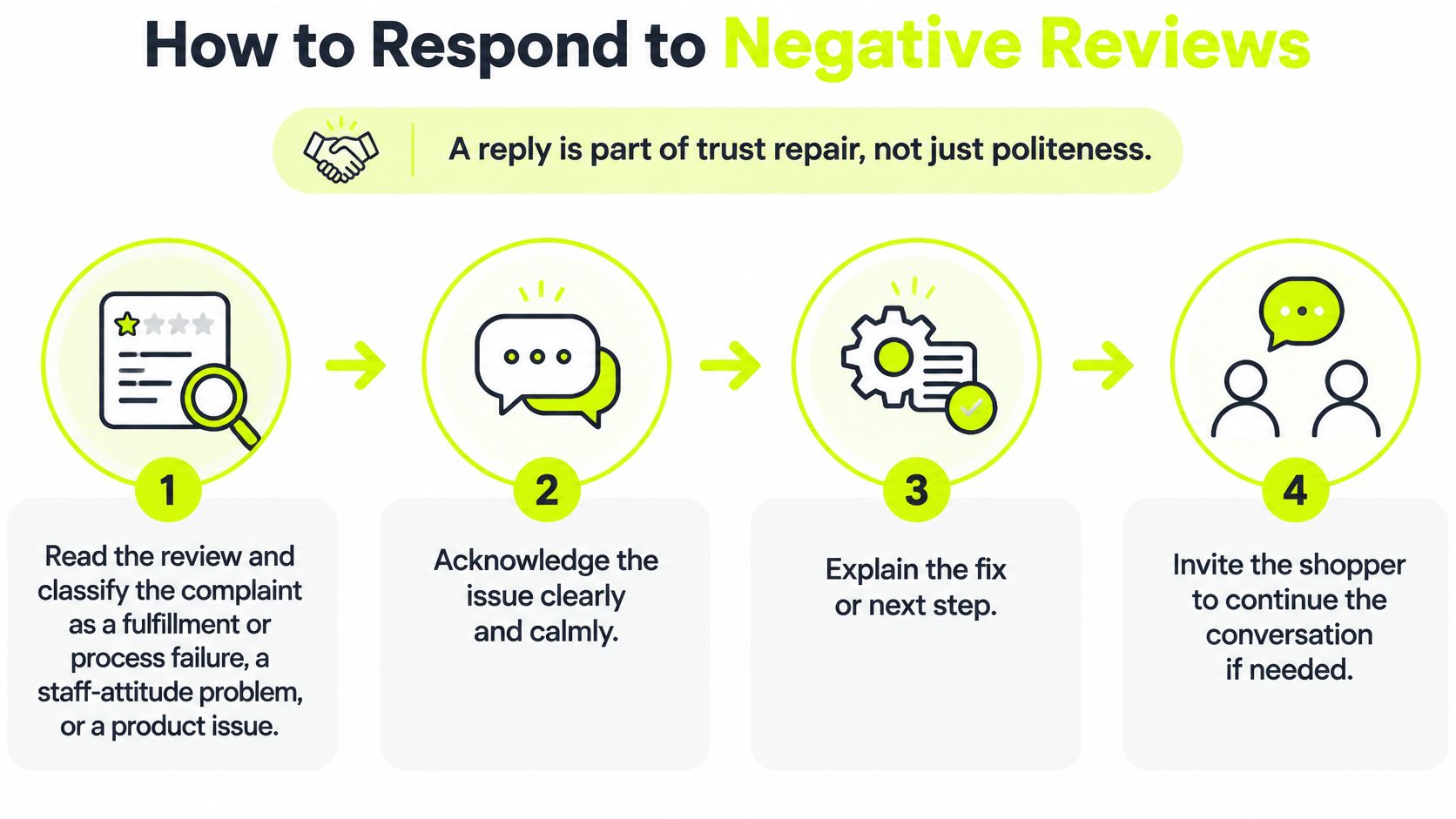
A public reply is a trust-repair job, not a courtesy. Research on how negative reviews affect retailers found that complaints about quality, attitude and fulfilment significantly reduce consumers' beliefs about a business's benevolence, integrity and competence, and those beliefs then shape purchase intentions. The same structural-equation study on negative reviews and trust repair found that different reply tactics work on different problems: explanations most broadly reduced perceptions of service problems, apologies worked best for attitude complaints, and compensation was most effective where quality had failed.
Seven Steps From Reading to Replying
- Classify the complaint before writing anything. Is it a fulfilment or process failure, a staff-attitude problem, or a verified quality defect? The classification decides the reply.
- Check the facts internally first. Pull the shift record, order history or stock file and settle what happened in private. Never argue the sequence of events in public.
- Choose the response type that matches. A specific explanation with a corrective action for process failures, a clear apology with acknowledgement for attitude problems, and proportionate compensation for a confirmed defect.
- Name the concrete failure and the change. "The card reader on till two failed at 5pm and we've added a manual override at the desk" does more work than any template sentence.
- Move case details to a private channel. Names, order numbers and contact details don't belong in a public thread, and asking the customer to continue by phone or email protects both sides.
- Keep any compensation separate from the review itself. Offering something in exchange for posting, changing or removing a review is against platform rules, so pay for the defect and say nothing about the write-up.
- Track what happened next. Response time, whether the same theme returns, how the rating moves afterwards, and footfall or sales at the affected location all tell you whether the reply did anything.
| Review type | Response approach | Reply should name |
|---|---|---|
| Fulfilment or process failure | Specific explanation with corrective action | The failed step and the fix |
| Staff-attitude problem | Clear apology with acknowledgement | The behaviour and the coaching or handover change |
| Verified quality defect | Proportionate compensation handled privately and separate from any review request | The defect and the remedy offered |
| Unverified claim | Check shift or order records before replying | Reply only after the facts are confirmed |
One caution sits under all seven steps. A reply alone doesn't rebuild lost trust. The change behind the reply does, and customers can tell the difference between a sentence written to close a thread and a process that moved. If the same complaint appears three weeks later, the reply failed regardless of how well it was worded. A broader set of online reputation fixes is worth reviewing when one response keeps repeating.
How a QR Feedback Program Runs in Practice
Guests are usually willing to say what they think. The gap is practical: between the till and the review page there is no obvious route, and at a busy counter there is no time for a script or a pitch. A QR program closes that gap by turning an awkward spoken request into a sticker the guest scans on their own.
The flow runs like this, with the reward and the contact list kept as separate steps.
- The guest scans the QR sticker on the table, at the counter or beside the till and opens the feedback page.
- The guest writes a Google review saying whatever they think. The reward does not depend on the star rating or the wording.
- review² verifies that the review has arrived. A click through to Google is not enough, so the coupon stays locked until a review is detected.
- The reward arrives as a live, animated coupon on the guest's own phone. Each one is single-use.
- Staff redeem it only against the live coupon. They mark it used and hand over the drink, small item or discount the business chose, and a still screenshot does not count. Nobody mentions the rating.
- Name and email collection sits behind an unticked opt-in. A guest who skips it still gets the reward.
- The owner reads a weekly summary covering new reviews, star ratings and progress, instead of refreshing Google by hand.
Because each step is its own feature, the program works as an operations signal rather than a star chase. The sticker drives volume, verification confirms a review exists, and the weekly report shows which themes keep coming back. What guests write stays theirs.
Using Incentives and Contact Lists Within the Rules
The question that separates a sound program from a risky one is short. Is the reward there for any honest review, or does it depend on what the reviewer writes? Everything else follows from that answer, because a review only works as an operations signal if the program never touches what the guest says.
In the United States, the Federal Trade Commission's Consumer Review Rule sets a floor rather than a permission slip. A business must not condition compensation on a positive or negative opinion, buy or fabricate reviews, or let insiders post without disclosing the relationship. Meeting that floor does not make an incentive program safe everywhere it runs, because platforms apply their own, often stricter, rules. Shoppers police the same line informally: BrightLocal's 2025 survey found that a large share of consumers treat a review as potentially fake when it looks like the result of a paid or incentivized agreement.
What the Platform Rules Add
Google's Business Profile review guidance goes further than the legal minimum. Reviews must reflect a genuine customer experience and must not be influenced by payment, discounts, or free goods and services. Offering incentives to post, change or remove a review is prohibited, and so is discouraging negative reviews or selectively asking only happy guests. Prohibited content may be removed, and enforcement can restrict a profile's ability to receive reviews or temporarily unpublish existing ones.
The distinction that matters: a reward can pay for the effort of writing, never for the words. The moment the reward depends on what the guest says, the program is tilting the signal it exists to collect.
That has a direct consequence for anyone running a rewarded program. review² keeps the incentive sentiment-neutral: the reward is issued regardless of star rating and guests are free to share any opinion. Google's position stays the same either way. It may remove reviews written in exchange for a gift or restrict a listing, and that decision belongs to Google, so no tool can guarantee that a review, rating or ranking stays published.
The audit checklist is short. The reward is identical for every guest. Staff never mention ratings, wording or edits. Records show the reward was issued without reference to sentiment, and nobody is offered anything to change or remove a review afterward.
Contact collection is a separate decision from review collection, and it follows marketing rules rather than review rules. The UK Information Commissioner's Office guidance on electronic marketing says marketing to individuals generally needs consent unless a limited soft opt-in applies, and valid consent must be informed, specific, freely given and based on a clear positive action. In practice that means an unticked box, a named sender, a stated message type and an unsubscribe route that takes one click instead of a login. review²'s guest database collects names and email addresses only from guests who consent, so the contact list stays separate from the review step. Rules differ by country, so check the one you trade in. If you're rewriting the ask itself, how to ask customers for feedback covers the wording.
Start a Weekly Review Routine This Week
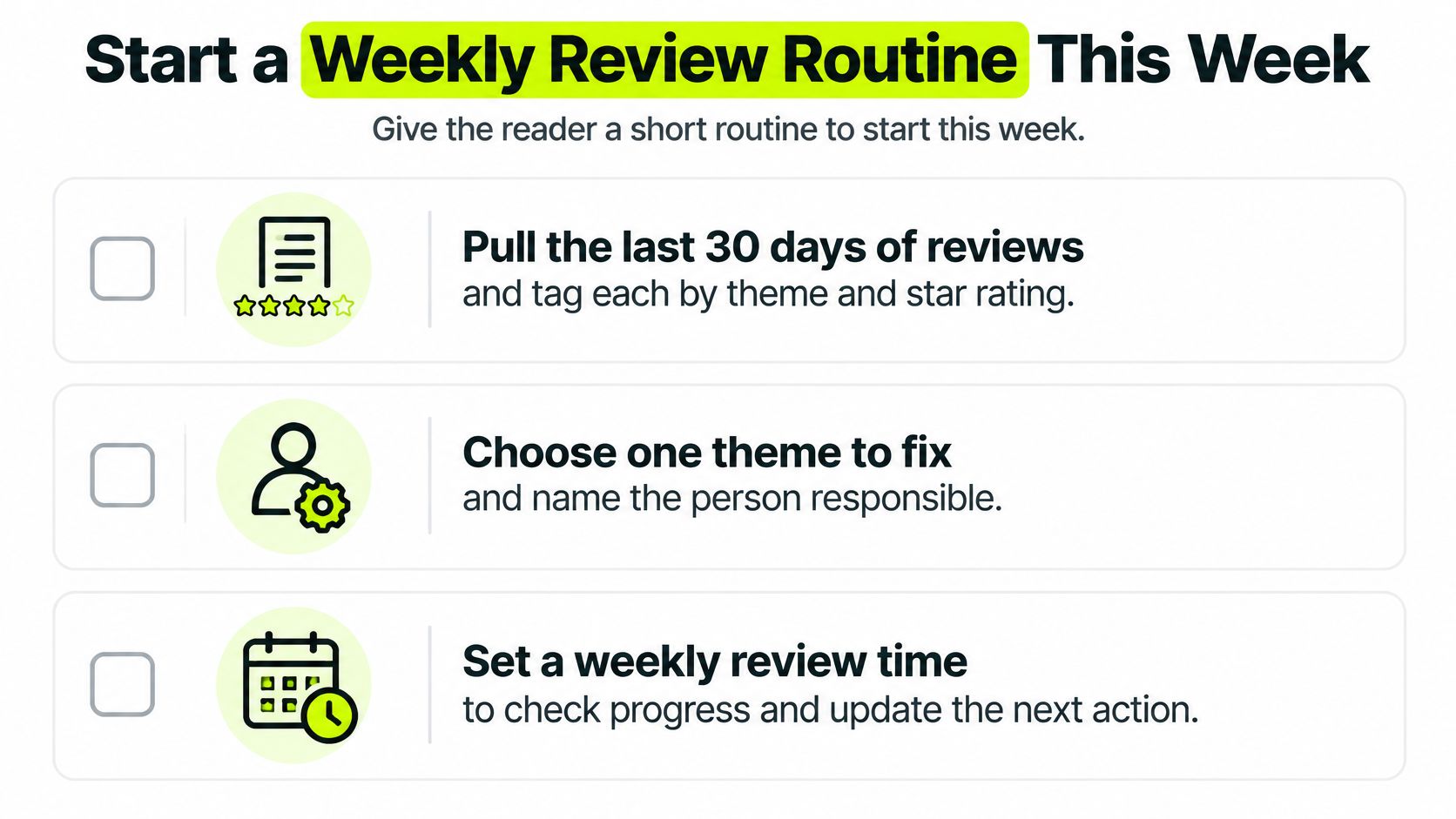
Six decisions, one hour, and the program is running rather than planned.
- Pull the last 30 days of reviews and tag each one by theme and star rating.
- Choose one theme to fix and name the person responsible for it.
- Set a reply rule: every negative review gets a specific reply inside a fixed window, and the window is written down.
- Write the incentive rule: the same reward for every guest, not linked to any rating, wording, revision or removal.
- Decide whether contact collection is needed at all. If it is, set an unticked opt-in that sits apart from the review step and names the sender and the message type.
- Set a weekly check that reads the summary report instead of refreshing review pages by hand.
Getting the mechanics live is a short job in review²: choose the business on Google Maps, choose a small reward, then order stickers with delivery included and place one on each table. Weekly email reports show new reviews, star ratings and progress, so nobody needs to keep checking Google. In 2024, 68% of UK consumers said online reviews were their primary source for purchasing decisions, per a Reputation survey reported by Internet Retailing, which is a lot of quiet research happening without you.
Pricing stays separate from the routine. Before quoting any figure to a partner or a finance lead, open the live pricing page and check the trial terms, the USD billing period, VAT treatment and any separately paid stickers or rewards. No figure belongs in a plan until it's been read from the current page.
If you want to see the guest side of the flow before committing to anything, the demo lets you look through it at your own pace with no obligation.
review² is built for the routine above: a QR sticker on the table, a small reward for any genuine review whatever the guest writes, verification that a review arrived before the coupon goes live, and a Monday summary of new reviews and rating movement. It keeps the reward, the contact list and the reply work in separate steps, so nothing guests say is filtered by what you hoped to hear. If that separation is the part you've been missing, review² will show you how it runs before you decide anything.