Reviews on Hairdressers: What Clients Check and Why
Learn how clients judge reviews on hairdressers, how salons gather feedback within Google's rules, and how to respond well.
How much does a 4.8-star average tell a client about the haircut they're about to book?
Two salons can carry the same rating and offer completely different information. One has forty reviews from the past three months, several of them about colour correction on previously bleached hair. The other has three hundred, the newest written two years ago, most of them a single line about friendly staff. The number is identical. What it means isn't.
Reviews on hairdressers get treated as a scoreboard. They work better as service notes: what was done, on what hair, at what price, and how it held up a fortnight later. This guide follows that idea through the whole cycle, from what clients read, to how a salon collects feedback without breaking platform rules, to how to reply when the feedback stings.
Why Clients Read Reviews Before They Book
A client with a wedding in three weeks has never met the stylist they're about to book. They open the salon's Google profile on a phone, read the last few comments, and decide in under two minutes.
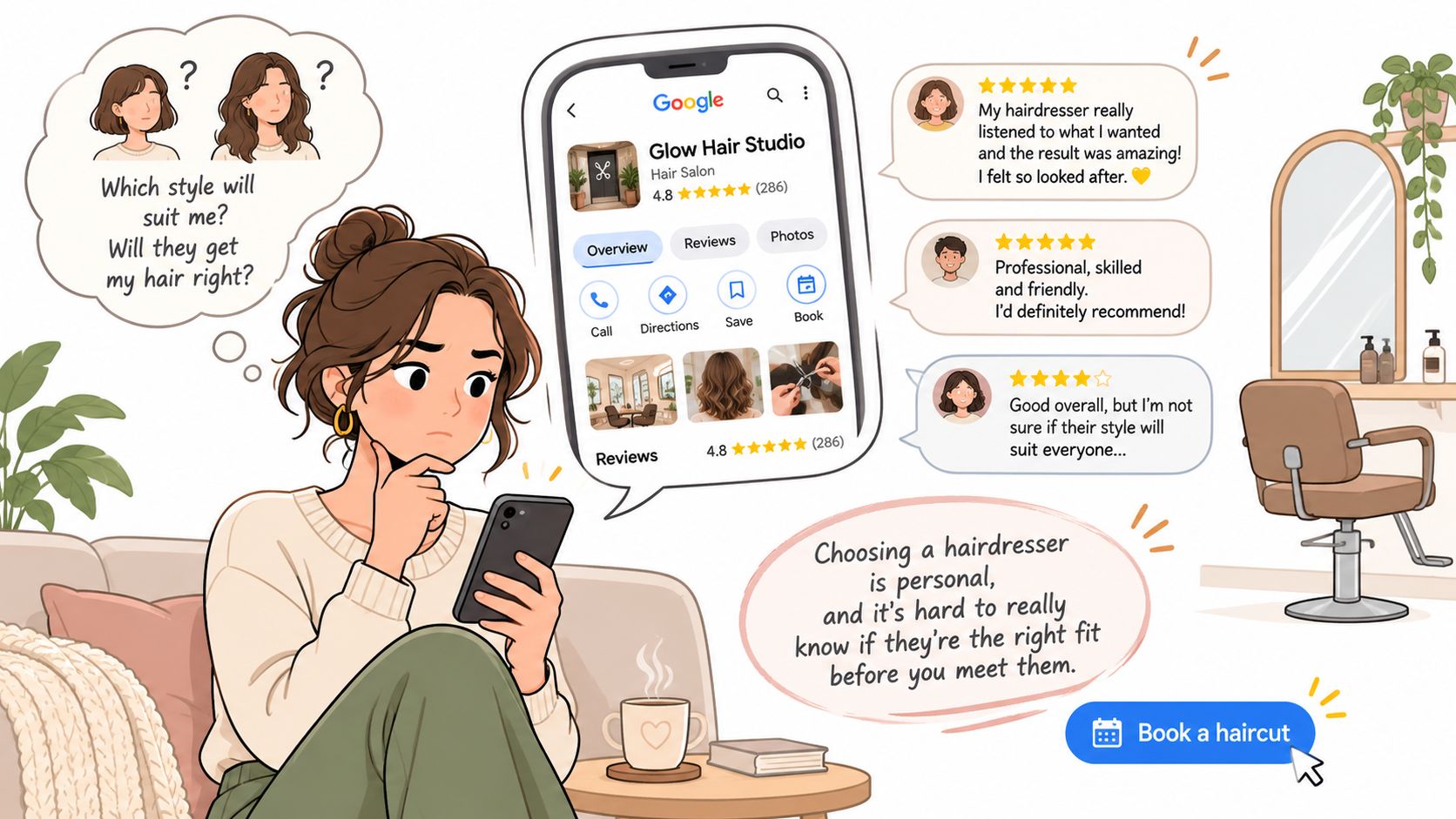
A haircut is a personal service with a delayed, visible result. A price list says what a cut costs. A portfolio shows the styles a stylist likes producing, usually on hair that isn't yours. Neither answers the question the client is really asking: will this person understand my hair, my reference photo and my budget?
Reviews fill that gap, and the habit is still widespread even as it softens. In 2025, 39% of U.S. consumers said they always read reviews before choosing a local business, down from 47% the previous year, according to GatherUp's survey of more than 1,000 U.S. consumers. A falling share doesn't mean reviews stopped mattering. It means fewer people read them out of habit and more read them at a specific decision point, usually minutes before booking.
Reviews do two separate jobs. Discovery comes first: someone searches for a curly cut, sees a list of salons, and the profile snippets decide which ones get a tap. Reassurance comes second: once the client is on the profile, the comments decide whether they book or back out. A salon can rank well in search and still lose the booking at that second stage.
Clients also read for different things. Some scan the average and stop. Others open the two-star comments first, because those are the ones with detail. Others look for a review that mentions their own hair type. Those are three distinct signals, and the rest of this guide separates them. By the end, a reader should be able to judge a review by its content rather than its star count, collect feedback without breaking platform rules, and reply in a way that builds trust with the next person who scrolls past. The broader set of review sites a local business can appear on matters too, though for a salon the local profile usually carries the most weight.
What Clients Look for in a Hairdresser Review
"Lovely salon, really friendly, would recommend." Five stars, posted last week. What does it tell you about the colour you're booking?
Almost nothing. Hairdressing is intangible and highly personalised, which is why a star average can't substitute for detail. A survey-based study of 510 hair-salon customers reported that 65.3% checked reviews before visiting, and review content was the most important review attribute for 37.8% of respondents. The same study's model found that review characteristics had significant positive effects on perceived value and satisfaction, with online reviews explaining 28.6% of the variance in perceived value and 32.1% of the variance in satisfaction. That's a large share, not the whole picture. Location, price and availability still decide plenty of bookings.
The practical conclusion is that specific comments outperform vague ones for the reader, and they give the salon something usable afterward.
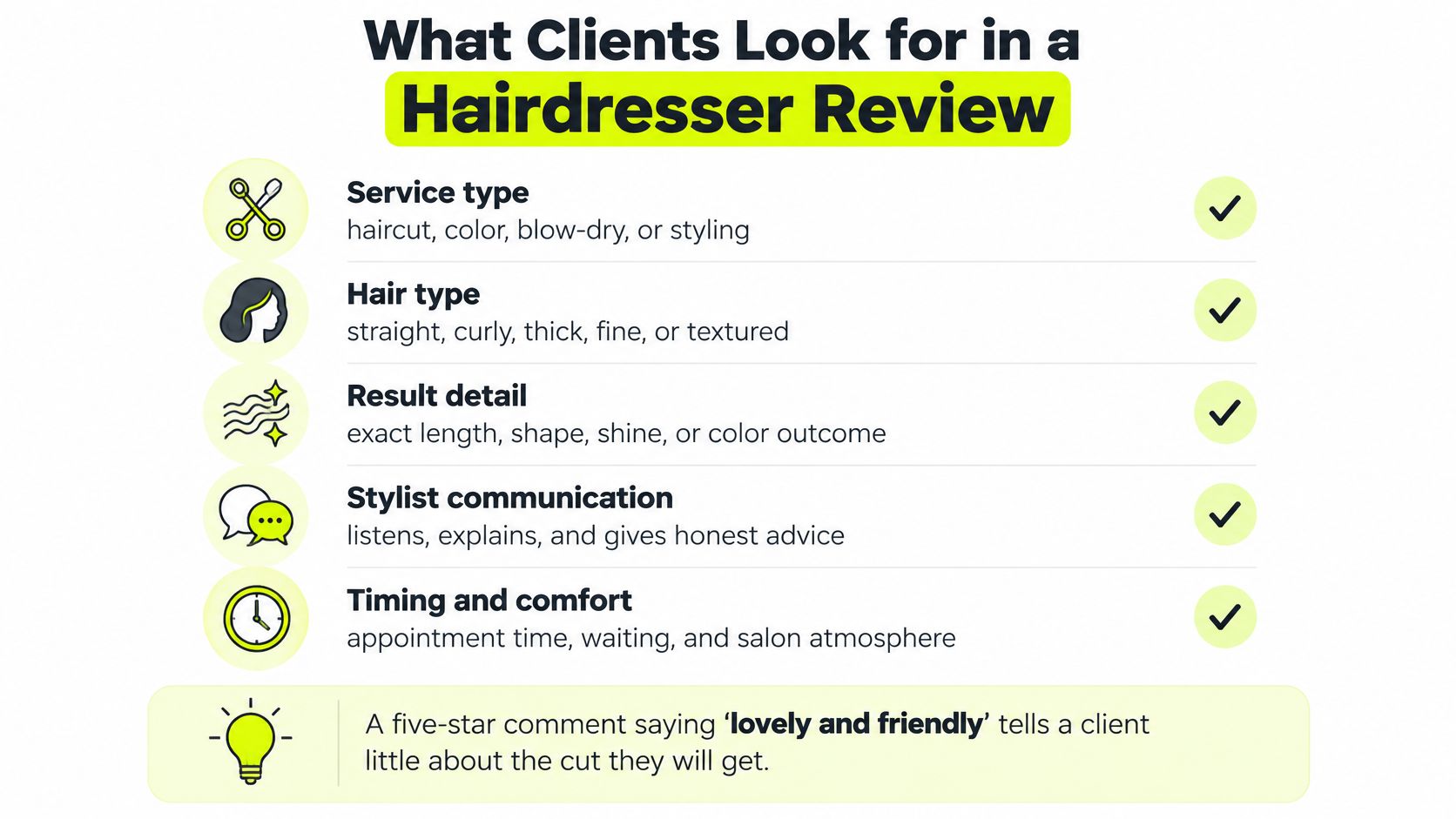
Seven details carry most of the weight. Read any profile through this grid, and the useful comments separate themselves from the noise.
| Review detail | What a useful review says | Example of the detail |
|---|---|---|
| Service type | Names the service: cut, colour, blow-dry or treatment | Full colour with toner |
| Hair type | Mentions texture, length, bleaching or past chemical services | Fine hair with previous bleach |
| Consultation | Says whether the stylist discussed a reference photo | Reference photo reviewed before cutting |
| Price | Notes whether the final bill matched the quoted price | Final bill matched the quote |
| Punctuality | Covers the start time and any waiting | Started on time or waited 15 minutes |
| Result | Describes the look after washing and styling | Still holding shape two weeks later |
| Aftercare | Explains the home-care advice given | Product and maintenance guidance |
The one-line rule: a useful review names what was done and what it looked like afterwards.
The detail about washing and styling at home is the one clients most often forget and most often need. A blow-dry looks excellent under salon lighting and can collapse after the first wash. A comment saying the shape held for two weeks answers a question the stylist's own photos can't.
A quick self-check on your own reviews
Open the last twenty comments on your profile and count how many mention a service type. Count how many mention hair condition. Count how many describe the result after a wash. If fewer than half pass, your reviews are working as mood reports rather than service information, and the fix sits in what staff ask guests, not in what guests are willing to write.
Reading Ratings, Volume and Recency Without Being Misled
A high average is a summary, not evidence. It can come from a steady run of fours and fives, or from a strong year in 2023 followed by a quiet slide nobody noticed. Three signals tell the difference.
What an average rating hides
Look at the spread of scores before you trust the headline. A profile with mostly fives, a handful of fours and two considered twos usually describes a salon that handles problems well. A profile with a wall of identical five-star lines and no detail anywhere is worth a second look, because uniformity is cheaper to produce than specificity.
Recency is the second check. Count the reviews posted in the last 90 days rather than the total. A salon with eighty reviews and twelve from this quarter is active. A salon with four hundred and none since last spring is coasting on history.
Recent volume moves before the average does. Review² publishes a 30-day before-and-after comparison from a Budapest bakery: 37 new Google reviews after the programme launched, against 3 in the 30 days before, which is 12.3× as many, with the average rating rising from 4.37 to 4.67 stars. A bakery isn't a salon, and results vary by business, so read the shape rather than the size. One month of new comments dilutes a long history; it doesn't rewrite it.
Read the replies before the rating
How a salon answers its lowest comments says more than how many fives it has. Calm, specific, consistent replies signal a business that reads feedback. Defensive replies, or none at all under the only two-star comment, tell a prospective client how a complaint would be handled after their own appointment goes wrong.
Reviews carry that weight partly because people treat them like personal advice. In 2025, 42% of consumers trusted online reviews as much as personal recommendations from friends and family, according to BrightLocal's Local Consumer Review Survey. That trust is exactly why the difference between a high average and a trustworthy one comes down to how the five-star reviews were collected.
One number worth holding loosely: research associated with Harvard Business School linked a one-star increase in a business's Yelp rating to a 5% to 9% increase in revenue, as summarised in salon-industry research on ratings. That's a correlation. Location, pricing, availability and service quality push both ratings and revenue, so no salon should bank the percentage as a forecast.
Ask three questions of any profile. How many reviews arrived in the last 90 days? Which services and which stylists do the newest comments describe? And how does the salon reply to its worst reviews?
Collecting Reviews Within Google's Rules
A salon offers a discount to anyone who leaves a review, and staff only hand the card to clients who seem pleased. It feels like sensible targeting. It breaks the rules twice.
Google's contribution policy prohibits businesses from offering incentives, including discounts, free goods, services or payments, in exchange for posting, revising or removing a review. It also prohibits selectively soliciting positive reviews or discouraging negative feedback. Google states that incentivized or biased content may be removed.
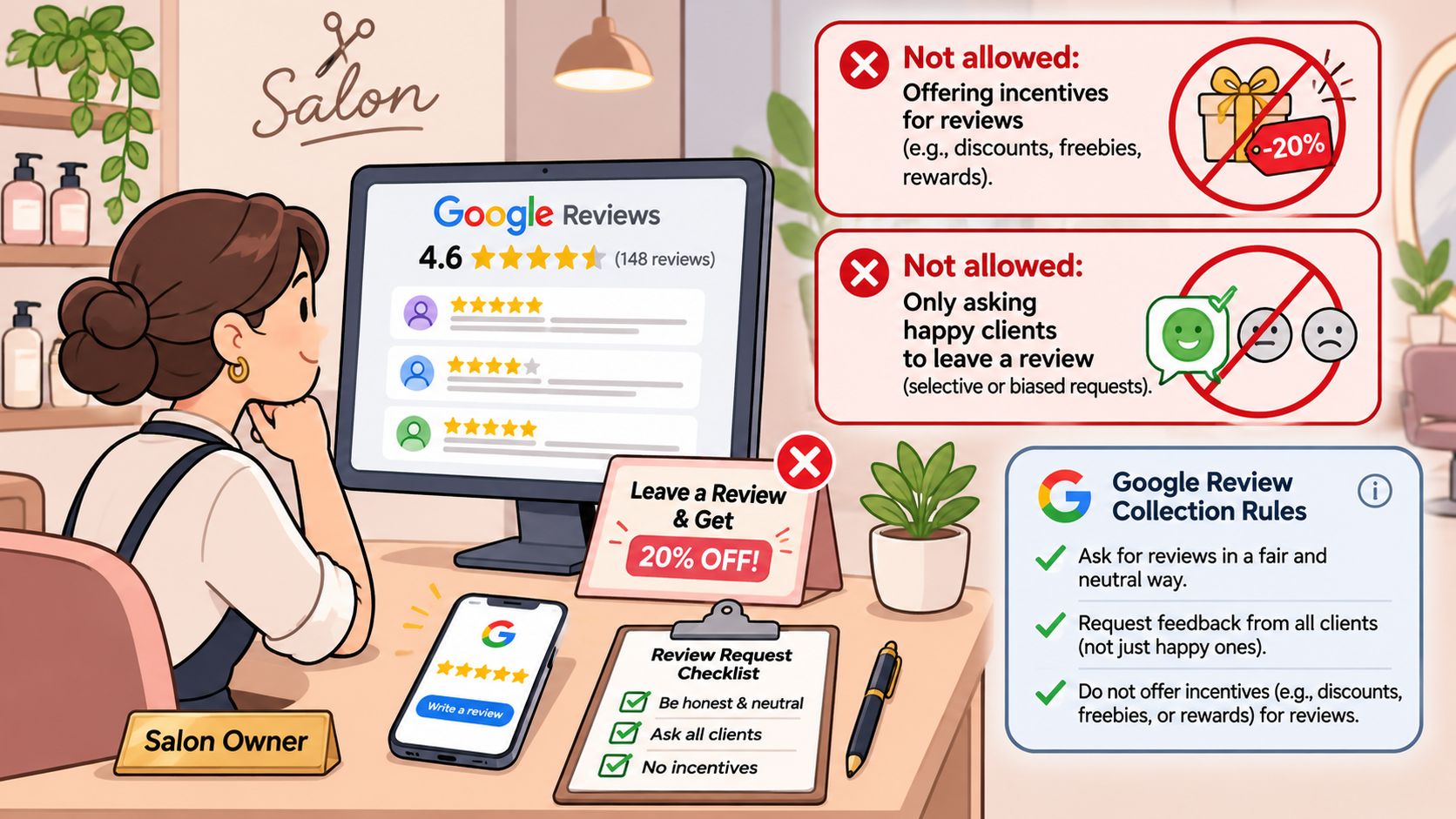
The distinction clients and owners both miss is that a review can describe a real appointment and still breach platform rules, because of how it was asked for. The visit being genuine doesn't fix the solicitation.
| Practice | Status under Google policy | Why it matters |
|---|---|---|
| Ask every genuine guest the same neutral way | Consistent with policy | Requests do not depend on the expected opinion |
| Offer a reward for leaving any review | Check current Google guidance before use | Incentives can lead to removal of reviews |
| Ask only happy clients to post | Prohibited | Selective solicitation is not allowed |
| Ask a guest to change or remove negative feedback | Prohibited | Discouraging negative feedback is not allowed |
| Buy reviews from unfamiliar accounts | Prohibited | Fake engagement can lead to restrictions |
| Reward guests whatever their star rating or opinion | Reduces bias risk, not a guarantee | Google still decides whether a review stays published |
"Incentivized or biased content may be removed." That sentence is the one to keep in mind when a marketing idea starts with the word reward.
What does this leave a salon able to do? Ask every guest, in the same words, at the same moment, without signalling the answer you'd like. Don't coach phrasing. Don't ask anyone to edit or delete a complaint. Never buy reviews from unfamiliar accounts, because fake engagement can cost a profile its ability to receive new reviews at all.
Review² sets out its own position on this. The reward is given regardless of the star rating, guests are free to share any opinion, and the service cannot guarantee reviews, ratings or rankings, because Google determines whether a review complies with its policies and stays published. Verification that a review has appeared is an operational check, not a compliance certificate.
Check Google's current guidance before running any campaign. Enforcement changes, and a workflow that was tolerated two years ago isn't automatically safe now. The practical guide to asking customers for feedback covers the wording side of that.
How a QR Review Program Works, Step by Step
The mechanics of a QR-led review program are simple. The mistakes happen in the same six places every time, which is why each step below comes with its common slip.
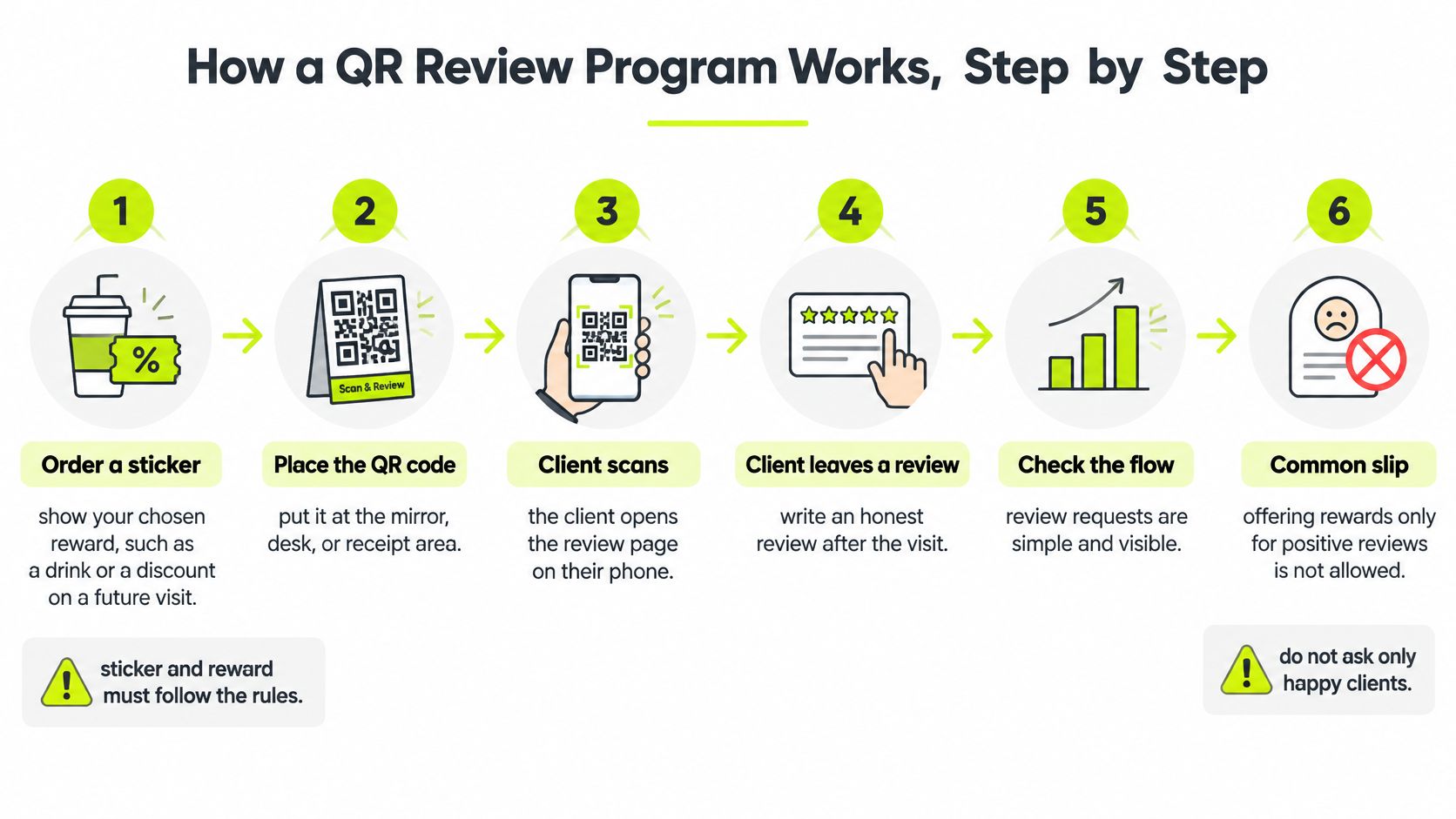
Order a sticker showing your chosen reward. Pick something you can offer every week without flinching, such as a drink, a small product or a discount on a future visit. Stickers and rewards are charged separately from the subscription, so budget for both lines. Common slip: choosing a reward you can't honour consistently, then not offering it.
Place the sticker where guests look. The mirror, the reception desk, a table card or the back of the receipt works. A discreet label on a door nobody reads does not. Common slip: placing it where staff find it convenient rather than where the guest sits waiting.
The guest scans and writes a Google review of their own experience. Staff explain the process neutrally and leave the room, metaphorically speaking. No suggested star rating, no sample sentences, no hint that five stars earns the reward. Common slip: a well-meaning stylist saying "if you're happy, mention it" and turning an open request into a nudge.
The service checks that the review has appeared. A click through to Google isn't completion. The system looks for the review itself before the reward becomes available. Common slip: treating that detection as certification of authenticity or as a promise the review stays published. It's neither.
When the review is detected, the guest receives a single-use coupon. Staff redeem it from the guest's live phone screen, with the animation running. Static screenshots get rejected, because a screenshot is shareable and a live coupon isn't. Common slip: accepting a saved image as proof, which turns one reward into three.
Optionally, the guest can share a name and email for marketing. This is a separate choice from the review, recorded as consent, with a working unsubscribe. Under UK Information Commissioner's Office guidance on electronic marketing, consent must be specific, given by clear positive action, and refusable without detriment. Common slip: pre-ticking the box, or making marketing permission a condition of getting the reward.
A business creates its sticker for its chosen reward, and the provider prints and delivers it to the door. Nothing in that chain changes the fact that the reward is available whatever the star rating, and that results vary. A guest who had a mediocre appointment and says so should still get the reward, because the alternative is a review program that only collects flattery.
Responding to Reviews and Tracking Patterns
Replies are written for the next client, not for the reviewer. Anyone deciding whether to book will scroll past the comment and read the response underneath it, which makes tone a sales asset.
How to reply so the next client trusts you
Three elements are enough for a positive review. Thank the guest by the name they used. Refer to the specific service they mentioned, so the reply reads as an answer rather than a template. Keep it to two or three sentences and stop.
For a negative review, the structure differs. Acknowledge the concern in plain words without conceding facts you haven't checked. Say what the salon will look at, whether that's the consultation process, the pricing conversation or the wait time. Invite the client to continue privately by phone or email. Never argue in public, and never hint at who the reviewer is, even when the appointment is obvious to staff. Identifying details in a reply about a hair complaint is a privacy problem as well as a service one.
Reply test: would a stranger reading only this response feel more comfortable booking? If the answer is no, the reply isn't finished.
Why a salon-wide rating misleads
Track reviews by stylist and by location, because an overall average can hide real differences between practitioners. In one U.S. salon-industry survey, 72% of respondents searched for salons on Google, and 49% said online reviews or reputation influenced their choice of current salon, according to American Salon's report on the survey. Google was substantially more common than social media for salon discovery, which supports a Google-first review routine rather than relying on Instagram portfolios alone.
A routine that fits a working week
A weekly email summary showing new reviews, star ratings and progress removes the need to open Google every morning; one arrives every Monday. Then once a month, sit down with the numbers and do four things. Count the new reviews by stylist. Group the comments by service type. Note any complaint that repeats, especially about punctuality or price clarity. Choose one change to test for the next four weeks, and write it down so the following month's comparison means something.
Choose Your Collection and Reply Process This Month
Three decisions carry most of the improvement, and none of them requires new equipment.
Decide which review details your team will ask about. Not a script, just a focus. If colour work brings vague comments, ask guests whether the final shade matched what they discussed. If punctuality complaints recur, ask about timing. One detail per quarter is enough.
Set a collection method that stays inside Google's rules. Every guest, same words, same moment, no conditions attached to a positive opinion. If you offer a reward, make sure it's available whatever the guest writes.
Fix a weekly time for replies. Thirty minutes, same slot, every week. Reply to everything new, then scan for patterns.
Three questions for the team this week. Which service generates the vaguest reviews, and why? Who currently replies to reviews, and does anyone check the tone? And which single review detail will you ask about first?
Review² runs this as a subscription with a 14-day trial for $1, then $29 per month, and there's no setup fee. Stickers and rewards are charged separately from the subscription, and VAT and other billing periods are listed on the site, so confirm current pricing there before you budget. Treat the published case-study numbers as business-specific illustrations rather than promises about review volume, ratings or rankings.
If the workflow above matches how your salon already works, review² is worth a look. It prints QR stickers for your chosen reward, checks that a guest's Google review has appeared, and issues a single-use coupon that staff redeem from the live phone screen, with a weekly email summary every Monday and an optional consent-based contact list. The reward is available whatever the guest writes, and the demo is the quickest way to see whether it fits your front desk.