Cost of Online Reputation Management: 2026 Price Guide
Find out the cost of online reputation management in 2026: monthly price ranges, pricing models, hidden fees and budget factors for local businesses.

Most businesses spend between $100 and $10,000 per month on online reputation management. Where a business lands inside that range depends on the service level it buys and the number of locations it has to cover, and the honest total includes a policy risk that rarely shows up on any invoice.
Reputation work has become a substantial market. Mordor Intelligence valued the global online reputation management market at $6.88 billion for 2025, and most of that money goes to unglamorous work: watching listings, answering reviews, keeping records and cleaning up mistakes.
That mix is why two quotes for the same restaurant can differ by a factor of twenty. One provider sells software. Another sells a person's time. A third sells the slow, expensive business of pushing a bad result off page one. Compare them on price alone and the cheapest option usually wins the wrong argument.
What follows separates the published benchmarks from the vendor rate cards, converts monthly figures into annual ones, and adds the line most guides leave out: the expected loss when a campaign breaks a platform rule and the profile loses visibility. Budget for that and the rest of the numbers get easier to judge.
Typical Monthly Costs by Service Level
Two proposals can quote the same service and land an order of magnitude apart, because "reputation management" covers different products. A monitoring subscription, a managed repair campaign and a crisis response can use identical words in a proposal and deliver completely different work.
A 2025 survey of more than 250 U.S. marketing and sales professionals found that 67% of businesses paid between $151 and $5,000 per location per month on reputation management, while 72% spent between $100 and $10,000 per month overall, according to the pricing research published by Nagent. The per-location figure is the one a multi-site operator should remember, because each extra venue brings its own listings, reviews and replies. Converted to annual terms, the same band runs $1,200 to $120,000 a year before taxes, advertising or public relations.
Typical reputation management costs by service level
| Service level | Typical cost | What it usually covers |
|---|---|---|
| Automated monitoring and review tracking | $50 to $500 per month | Review alerts, tracking and basic reporting |
| Software for ten locations | $131 to $800 per month | Review monitoring and reply drafting across listings |
| Hands-on repair and search-result suppression | $500 to $7,000 per month | Human response management and suppression work |
| Enterprise or crisis program | $10,000 to $50,000 or more per month | Escalation paths, multiple platforms and crisis handling |
| Permanent removal of one piece of content | $500 to $15,000 or more per link | Source-site negotiation, legal review and technical SEO, usually one time |
Reading the rows as rungs
Monitoring and tracking is the software tier, and published market benchmarks put it at roughly $50 to $500 per month for alerts, review tracking and reporting. Hands-on repair and suppression costs about $500 to $7,000 per month, because a person now writes, publishes and pushes. Permanent removal of a single piece of content is priced per link at $500 to $15,000 or more, typically as a one-time project that needs source-site negotiation, legal review, technical SEO and replacement content.
The ten-location and enterprise rows jump by an order of magnitude because the work at that scale is done by people. Staffing an escalation path that answers at 2am costs more than any dashboard.
Budget rule: price the problem you have today, then add one row above it for the quarter when something goes wrong.
Most rows recur; the removal row does not. That difference matters when you compare quotes, because a $2,000 monthly retainer reads like a small line item until it is $24,000 a year and the same again the year after, while a removal project can end with the invoice.
The monthly figures also hide the riskiest number in the table. A repair campaign that breaks a platform rule can turn a modest retainer into removal work billed per link, so the cheapest recurring row is not always the cheapest year.
Start with the row that matches your situation now. A café with a healthy profile and steady review volume belongs in the top row. The same café with a viral complaint and a local news story belongs two rows down.
What Moves Your Reputation Budget Up or Down
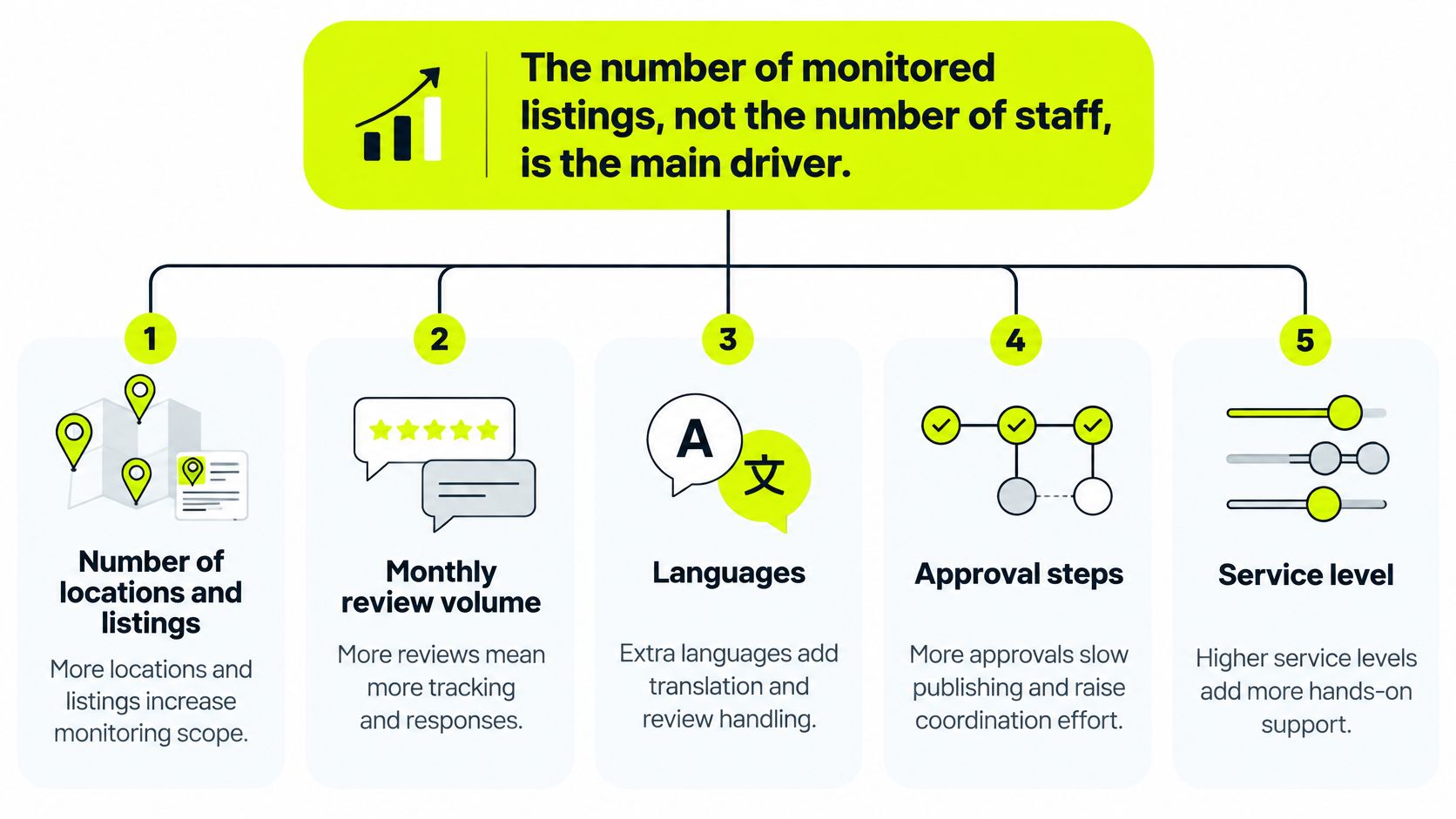
Headcount is the wrong unit of measurement. The number of monitored listings is the driver, and everything else scales from there.
A benchmark drawn from published software rate cards reports about $131 to $800 per month for ten locations when the scope is review monitoring and reply drafting, while enterprise or crisis programs reach $10,000 to $50,000 or more per month, per Market Intelligence Tools. None of that gap involves the number of employees. It comes from monitored listings, review volume, approval workflows, response deadlines, languages and escalation paths.
The drivers in order of impact
- Listings under management. Ten profiles generate ten times the alerts and replies of one, and every new venue adds its own reviews from day one.
- Monthly review volume. A venue collecting 200 reviews a month needs faster triage than one collecting 20, and triage is where the labour sits.
- Languages. Each extra language adds translation or a bilingual responder, and Google won't sort the queue for you.
- Approval steps. A reply that needs owner sign-off takes longer to publish, and every extra approver adds coordination hours.
- Response deadlines and escalation. A guaranteed reply window plus a named escalation contact is a staffing commitment, not a software toggle.
The cost of online reputation management, seen this way, is a scope decision made once and then paid monthly.
Billing structure decides how those drivers hit your invoice. Per-location pricing multiplies the fee by every venue you add. A flat subscription works differently: review²'s monthly plan starts with a 14-day trial for $1, then costs $29 per month, and one subscription covers all of a team's locations, with at least one location always billed. A ten-site group on that basis pays the same $29 as a single café, before rewards and sticker orders, which lands below the published $131 to $800 band for ten-location monitoring. The comparison holds only where the functionality overlaps: review monitoring, verification and reporting.
The limit matters. Active search-result suppression, public-relations response, legal coordination and crisis management are separate cost layers and can't be lined up against a monitoring subscription. If the search results are the actual problem rather than the reviews, the work is a different project with a different price, and fixing a damaged online reputation is where that work starts.
The invoice is also only part of the budget. Any program built around rewards carries a policy exposure: Google can remove reviews written in exchange for a gift or restrict a listing, and no vendor controls that decision. review² verifies that a Google review has arrived before a reward is ready and states plainly that it cannot guarantee reviews, ratings or rankings, which is the honest framing for this category. Price the plausible loss alongside the subscription, because a wiped review profile costs more to rebuild than a year of monthly fees.
List every location, estimate the monthly review volume for each, and decide which reply tasks stay in-house before asking anyone for a quote.
That order matters because a provider prices what you describe. Describe five locations and 40 reviews a month and you get a software quote. Describe five locations, three languages and a legal sign-off on every reply, and you get an agency quote with a much larger number.
Pricing Models and What Each One Covers
Five billing structures dominate this market, and they solve different problems. The table sorts them by how they're charged, who they suit and where the risk sits.
Reputation management pricing models compared
| Pricing model | How it is billed | Best fit | Watch for |
|---|---|---|---|
| Monthly software subscription | Fixed monthly fee | Single site or small group focused on monitoring and reply drafting | Limited human support and no crisis handling |
| Per-location subscription | Fee multiplied by each venue | Multi-location restaurants, cafés and bakeries | Total rises quickly as sites are added |
| Annual software contract | One yearly payment or annual plan | Businesses committed to a stable process over 12 months | Cancellation terms and unused time |
| Agency retainer | Monthly fee for ongoing human management | Businesses with high review volume or multiple platforms | Monthly costs can reach several thousand dollars |
| One-time removal project | Fee per piece of content | A specific damaging result that needs a single fix | Costs can reach $15,000 or more per link and don't stop future reviews |
What a mid-market contract looks like
Enterprise software sits far above the small-business tier. For 2025, DataIntelo put the average annual contract value for a mid-market online reputation management software subscription at approximately $24,000 in its online reputation management market report. That figure describes buyers with multi-platform scope and several stakeholders, not an independent bakery with one listing.
At the subscription end, review² publishes three plans, all excluding VAT and all carrying the same features: $29 a month on the flexible monthly plan, $114 every six months (about $19 a month, saving 34%) and $174 a year (about $14.50 a month, saving 50%). Each plan opens with a 14-day trial that costs $1, charged when the trial begins, and a payment card is required. There is no setup fee, and one subscription covers all of a team's locations, with at least one location always billed.
The invoice still understates the budget. The business sets and funds its own rewards, sticker orders are paid separately (printing and worldwide delivery come with the sticker price, replacements are quoted before ordering), and the average cost per review runs about $0.90. On top of that sits the exposure no plan can remove: Google decides whether an incentivized review complies with its policies, may remove it or restrict the listing, and review² does not guarantee that reviews, ratings or rankings hold. A realistic budget treats that policy risk as a cost line, the same way it treats coupons and sticker orders.
The last check before quoting any of these figures is the billing basis. review² bills per team, but other vendors do multiply the fee by venue, and a per-location reading of the same headline price produces a very different annual total. Read the current pricing page rather than a reseller summary before you model several sites against one.
What Reputation Neglect Can Cost Over Time
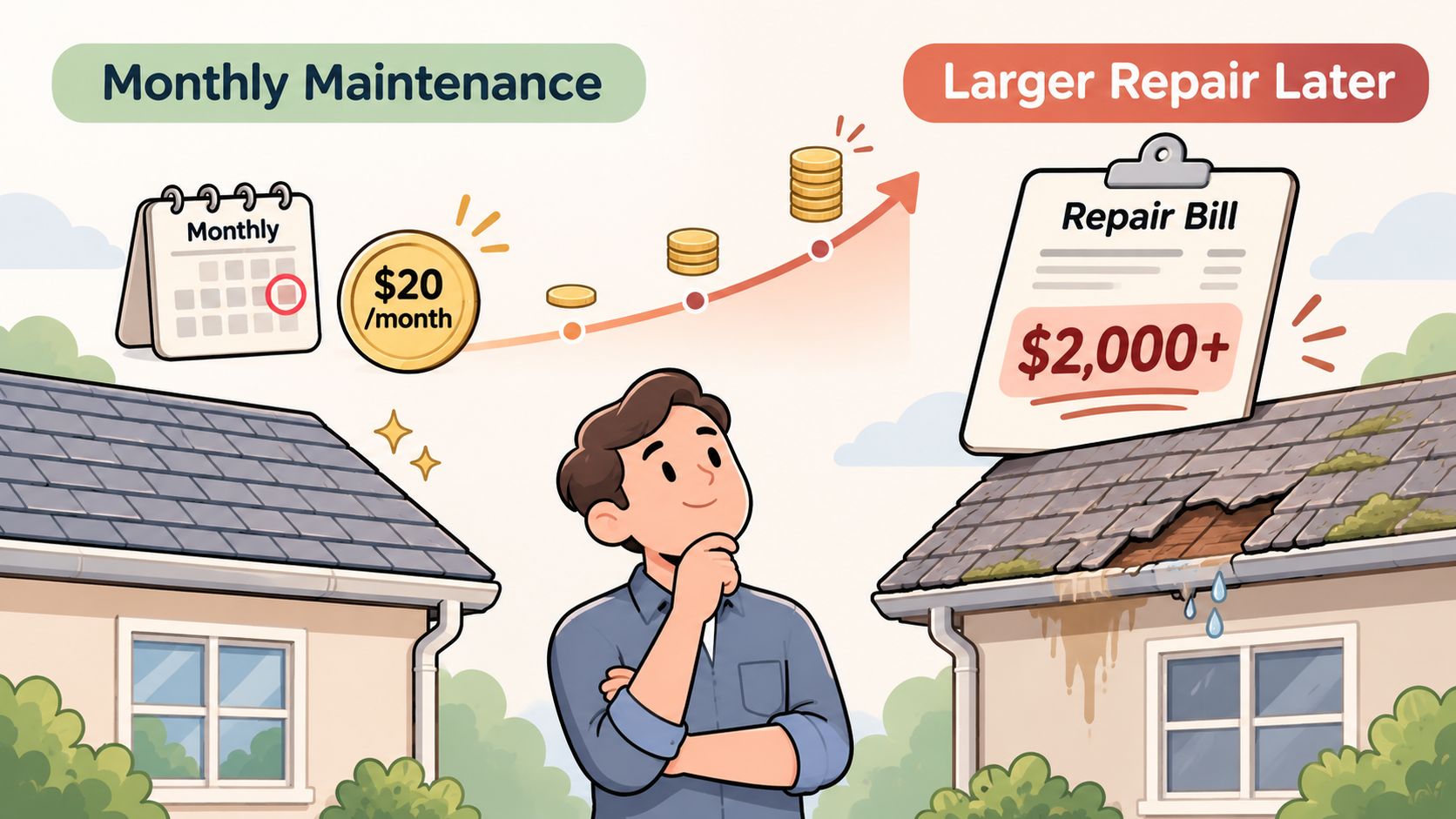
Treat the monthly fee like roof maintenance. A small recurring spend keeps the weather out, and skipping it for three years delivers the whole repair bill at once, with scaffolding.
The evidence for that analogy is financial rather than cosmetic. A peer-reviewed study of litigation, fraud and cyberattack events from 2000 through 2018 found that reputational damage after public scrutiny was linked to lower government subsidies and fewer major transactions, which the study calls “Mega Deals,” and that reputational damage constrained the value firms gained from subsidies, as set out in the study of reputation and firm value.
What the study actually shows
It shows where the exposure hides. The study doesn't put a dollar price on reputation management, and it doesn't prove that any particular review subscription prevents a specific loss. What it does is treat reputation as an economic asset rather than a marketing metric, and trace how damage reaches channels a restaurant owner rarely watches:
- Incentive eligibility. Support and subsidy decisions are made by people who read the news.
- Negotiating position. A landlord or supplier who has seen a public complaint prices that risk into the deal.
- Partnership options. Fewer credible partners means fewer cross-promotions, events and wholesale accounts.
- Financing terms. Lenders and insurers ask about disputes, and a documented pattern of them changes the answer.
Compare the recurring cost against the revenue at risk from a visible reputation drop in your best month, not against the advertising budget.
For a bakery, that comparison is concrete. Six weeks of lost weekend trade is a bigger number than a year of monitoring, and the customer who reads a wave of unanswered one-star reviews doesn't distinguish between an old staffing problem and a current one. Reviews written about the experience itself are what carry that weight, which is why getting reviews to work harder for search belongs in the same conversation as the budget.
None of this argues that a subscription prevents these outcomes. It argues that the comparison should include them.
Incentive Rewards and Their Hidden Risk
Most cost guides treat a reward program as an ordinary campaign line: coupon cost times redemptions, plus a bit of admin. Google's rules change the arithmetic, because the loss isn't only the coupon.
Google's merchant requirements prohibit offering financial incentives for reviews, including discounts, free samples, gift cards and other monetary value. Violations can trigger removal of reviews and restrictions on the profile, including loss of eligibility to receive new reviews or temporary unpublishing of existing reviews, according to Google's merchant review policy. Enforcement is active, which means part of what a business pays to collect can disappear after it has already been paid for.
What the platform rules actually say
The Maps user-generated content policy fills in the detail. It prohibits payment, discounts and free goods or services in exchange for posting, revising or removing a review, bars soliciting content that doesn't reflect a genuine experience, and rules out discouraging negative reviews or selectively requesting positive ones, per Google's prohibited and restricted content policy. Incentivized or biased reviews may be removed, and that decision belongs to Google.
So the cost question becomes expected value rather than coupon cost. Multiply participation rate by reward cost, then by the share of reviews that survive enforcement, then by incremental bookings and average customer value. Then subtract the probability of enforcement multiplied by its impact: deleted reviews, a lost ranking position, or weeks where the listing can't collect anything new. That subtraction is the part most budgets skip, and it is what turns a cheap reward program into an expensive one.
Verification narrows one gap without closing the policy one. review² checks that a Google review has arrived before the reward becomes available, and a click through to Google isn't enough, which stops a business paying out rewards for visits that never produced a review. It doesn't make a review compliant, it can't guarantee that reviews, ratings or rankings will hold, and Google decides what stays published.
Compliant structure: reward private feedback or survey participation, keep the reward independent of rating and wording, and invite a public review separately with nothing conditional attached.
That structure also handles the consent problem. A guest's consent needs to be specific, informed and freely given rather than buried in a coupon claim, and no guest should have to join a marketing list to receive a reward they earned.
Read the current policy pages before a campaign goes live, not after the first reviews vanish.
Building a Budget for One Location or Many
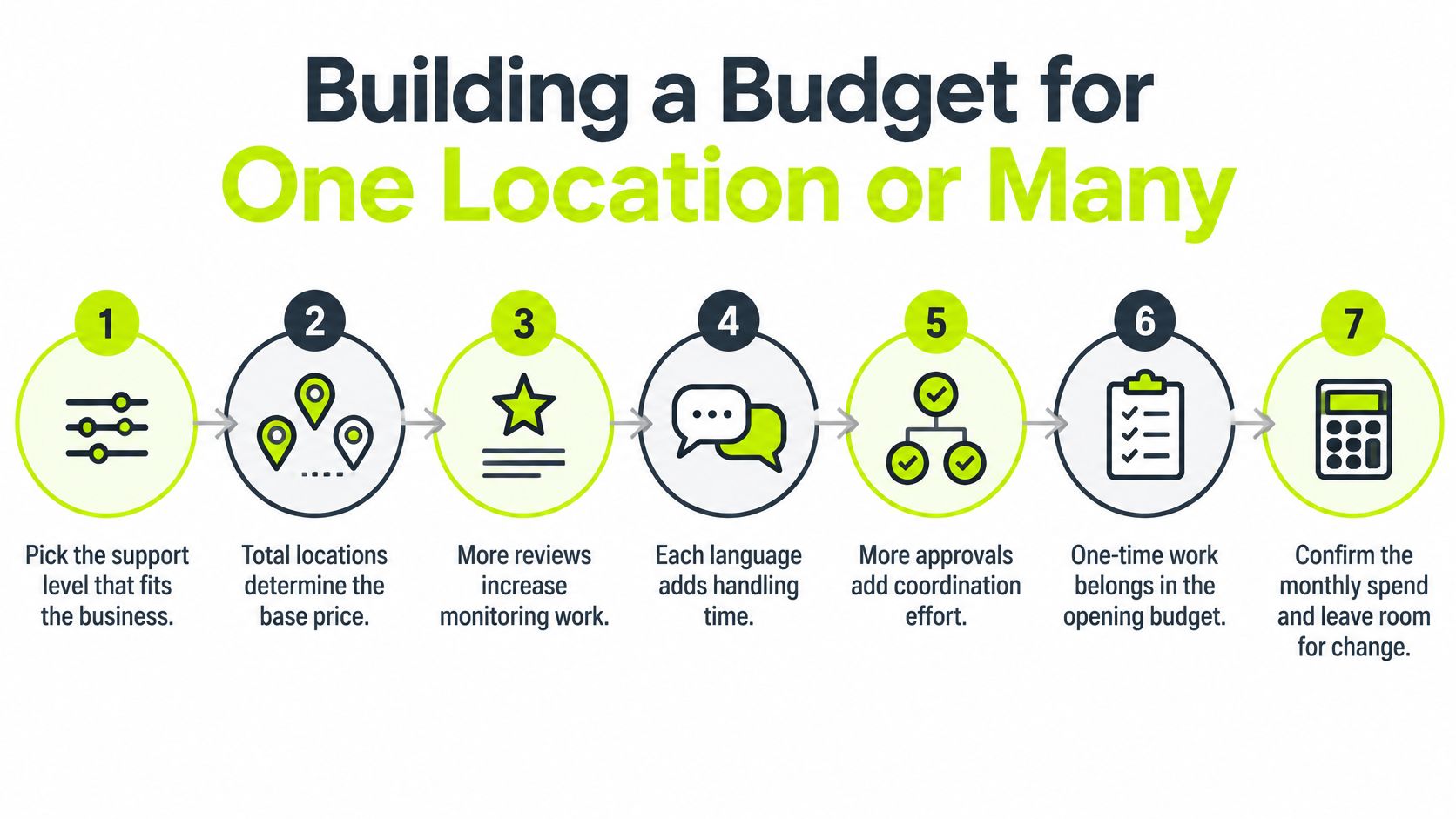
A budget you can defend takes seven steps and roughly an afternoon. The output is one monthly number that includes the invoice, the operating costs around it, and a reserve for the month something goes wrong.
- Pick the service level. Name what you're buying from the table in section one: monitoring, managed repair or crisis cover. Blurring them into one line item hides the cost of each.
- Count locations. The number determines which billing basis applies to you and how much review volume you're managing, so include the quiet venues that still carry a listing.
- Confirm the billing basis. Check the current pricing page for whether the fee is per location or covers the whole team, because published descriptions differ. A review² subscription covers all of a team's locations, with at least one location always billed.
- Cost the rewards monthly. Estimate redemptions rather than guests, then multiply by what the reward costs you to serve.
- Add stickers properly. The sticker price includes printing and delivery worldwide, each order ships with 10% spare stickers, and replacement orders are paid separately at the price shown before ordering.
- Add VAT or local sales tax. Listed prices usually exclude it, so a $29 plan isn't $29 out of the bank.
- Price the hours and the reserve. Replies, approvals and coupon redemption use staff time. The reserve covers the costs that never appear on a quote: a run of reviews removed under Google's incentive policies, a listing that stalls while you rebuild volume, or the staff hours a cleanup absorbs. Size it as a share of the monthly total, not an afterthought.
Monthly budget worksheet
| Budget line | How to calculate |
|---|---|
| Subscription | Plan price converted to a monthly figure; a review² plan is billed per team, not per site |
| Rewards | Expected redemptions × reward cost |
| Stickers | Order price spread over its life, plus replacements |
| VAT or sales tax | Local rate applied to listed prices |
| Staff time | Hours for replies, approvals and redemptions × hourly cost |
| Reserve | Share held back for review removals, a stalled listing or a repair bill |
A worked example with round numbers
Take a three-site bakery group on review²'s monthly plan. One subscription covers all three locations, so the subscription line is $29 a month before rewards, stickers, tax and staff time. Add rewards at the expected redemption count, spread a sticker order across the months it covers, apply local tax, and allow two manager hours a month. Then add the reserve: if incentive-driven reviews are ever removed, the cost is the lost review volume and the recovery period, not the coupon. The total lands well above $29, and that full number is the one to compare with a competitor's quote.
Rebuild the worksheet every quarter. Location count and review volume both move, and so does the total. If you want a second opinion on where review traffic comes from before committing, the list of review sites that matter for local businesses is a useful starting point.
Confirm Your Numbers Before You Commit
The right budget comes down to four things: location count, review volume, how much human handling you need, and how much policy risk the business can carry. Everything else is a variation on those.
The checklist to run before signing
- Price and period. Confirm the current price per location and per billing period on the live pricing page, not in a comparison article.
- Tax. Check whether VAT is added to the figure shown, and at what rate.
- Trial terms. The 14-day trial costs $1, charged when it starts, and requires a payment card. There's no setup fee.
- Separate costs. Rewards and sticker orders fall outside the subscription, and replacement sticker orders are paid separately at the price shown before ordering.
- No promises. A provider that guarantees reviews, ratings or rankings is promising something it doesn't control. Google decides which reviews stay published.
Questions about subscriptions, payments or invoices go to support@reviewreview.io, and questions about the website or terms go to info@reviewreview.io. Accounts are created and subscriptions started in the review² app.
review² is one option for collecting guest feedback and Google reviews, built around QR stickers, review verification, single-use reward coupons and weekly email reports that show new reviews, star ratings and progress. The sample QR pages on the site demonstrate a possible guest experience but don't publish a Google review, verify one or issue a reward, so treat them as a walkthrough rather than a demo of a live review.
Compare two or three options against the same worksheet, and look at the demo before committing to a year.
review² gives local businesses a way to make review collection predictable: guests scan a QR sticker, leave a Google review, and a single-use reward coupon becomes available only after the service verifies that the review has arrived. Subscriptions run at $29 a month, $19 a month on the six-month plan or $14.50 a month on the annual plan, with rewards and stickers billed separately and no setup fee. Visit review² to see how verification, coupons and weekly reporting fit into the budget you've just built.